Radweg EuroVelo: Atlantikküstenroute - Teil Schottland - Irland - Wales
Nr. des Radweges EV1
Aktionen

Bitte warten - Kartendaten werden geladen
Erstellt am 02.11.2019,
zuletzt geändert von biroto-Redaktion am 09.11.2023
Aktionen
Strecken-Merkmale
Gesamtlänge in km
4.117
Informationen zu Rechten an den GPS-Track-Daten | |
|---|---|
Rechte-Inhaber | OpenStreetMap and Contributors + biroto-Redaktion (biroto.eu) |
Rechte-Ausprägung / Lizenz | Enthält Daten von OpenStreetMap, die hier unter der Open Database License(ODbL) verfügbar gemacht werden |
Link zur Rechtebeschreibung | |
gpx-Datei übernommen aus | |
gpx-Datei hochgeladen | durch biroto-Redaktion am 09.11.2023
|
Gesamtzahl Trackpoints
68.258
Trackpoint-Dichte per km
16
Endorte
Start
Aberdeen, SCT, GB (7 m NHN)
Ziel
Plymouth, ENG, GB (2 m NHN)
Informations-Quellen
Portale:
Fahrradfreundliche Unterkünfte, Sehenswertes und Infrastruktur
Name u. Anschrift
Breite / Länge
Tel.
Fax.
Mobile
Art d. Unterkunft
Radler-freund-lichkeit
Strecken-km
km zur Strecke
Höhe
7 km
2,1 km
55 m
7 km
2,0 km
56 m
170 km
0,3 km
33 m
Informationen zu Urheber-Rechten | |
|---|---|
Rechte-Inhaber | |
Rechte-Ausprägung / Lizenz | by-sa: CREATIVE COMMONS Namensnennung, Weitergabe unter gleichen Bedingungen |
Link zur Rechtebeschreibung | |
Bild übernommen aus | https://commons.wikimedia.org/wiki/File:Elgin_cathedral_2.jpg |
Bild hochgeladen | durch biroto-Redaktion am 12.12.2020
|
Informationen zu Urheber-Rechten | |
|---|---|
Rechte-Inhaber | |
Rechte-Ausprägung / Lizenz | by-sa: CREATIVE COMMONS Namensnennung, Weitergabe unter gleichen Bedingungen |
Link zur Rechtebeschreibung | |
Bild übernommen aus | https://commons.wikimedia.org/wiki/File:Spynie_Palace2_660.JPG |
Bild hochgeladen | durch biroto-Redaktion am 12.12.2020
|
Die Stadt Elgin liegt am Fluß Lossie in Schottland. Sie ist Verwaltungssitz der Council Area Moray  . Die Stadt liegt rund 10 km von der Küste entfernt.
Hintergrund
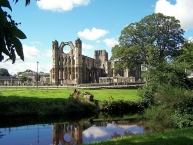
In einer Schlacht bei Elgin tötete am 14. August 1040 Macbeth (Mac Bethad mac Findlàich, * 1005; † 15. August 1057) den schottischen König Duncan I. und wurde selbst zum König von Schottland. David I. erhob Elgin 1136 zur Royal Burgh. 1224 wurde auf Veranlassung von Papst Honorius III. eine Kathedrale errichtet und Elgin wurde Domstadt. Die Kathedrale wurde The Lantern of the North (Leuchte des Nordens) genannt und in der Zeit der Reformation zerstört. Die Ruine ist heute noch in der Stadt präsent. 1196 wählte Eduard I. Elgin Castle zu seinem Stützpunkt. Überreste sind noch heute auf dem Lady Hill zu sehen, dort wurde 1839 ein Denkmal für George V., den letzten Duke of Gordon, errichtet. Elgin liegt am Scotland's Malt Whiskey Trail.
Sehenswürdigkeiten
Kirchen
- ⊙Elgin Cathedral.
 . Ruinen der Kathedrale aus dem 12. Jahrhundert Geöffnet: 1. April - 30. September, Mo Di Mi Do Fr Sa So, 9:30 bis 17:30 (Letzter Einlass 17:00); 1. Oktober - 31. März, Mo Di Mi Do Fr Sa So, 10:00 bis 16:00 (Letzter Einlass 15:30). Preis: Erwachsene £5.50, Kinder £3.30. letzte Änderung: Aug. 2015.
Burgen, Schlösser und Paläste
- ⊙Elgin Castle. . Überreste des Elgin Castle aus dem 12. Jahrhundert auf dem Lady Hill letzte Änderung: Aug. 2015.
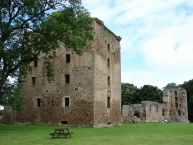
- ⊙Spynie Palace. . Ruine des Landsitzes der Bishöfe von Moray Geöffnet: 1. April bis 30. September, täglich 9.30 bis 17.30 (Letzter Einlass 17.00). Preis: Erwachsene £4.50, Kinder £2.70; Kombiticket mit der Kathedrale von Elgin Erwachsene £7.20, Kinder £4.40. letzte Änderung: Aug. 2015.
Denkmäler
- ⊙Duke of Gordon Monument. 1839 errichtet, George V. dem letzten Duke of Gordon letzte Änderung: Aug. 2015.
Museen
- ⊙Elgin Museum, 1 High St, Elgin IV30 1EQ. ☎ +44 1343 543675. Geöffnet: April bis Oktober Mo bis Fr 10:00 bis 17:00 Sa 11:00 bis 16:00. letzte Änderung: Aug. 2015.
Aktivitäten
- ⊙Glen Moray Distillery, Bruceland Road, Elgin IV30 1YE. ☎ +44 1343 550900. Die Distille ist Teil des Scotland's Malt Whiskey Trail. Eine Reservierung für eine Besichtigung wird empfohlen Geöffnet: 1. Mai - 30. September, Mo - Fr, 09:00 bis 17:00, Sa 10:00 bis 15:30; 1. Oktober - 31. April, Mo - Fr, 09:00 bis 17:00. letzte Änderung: Aug. 2015.
Informationen zu Urheber-Rechten | |
|---|---|
Rechte-Ausprägung / Lizenz | by-sa: CREATIVE COMMONS Namensnennung, Weitergabe unter gleichen Bedingungen |
Link zur Rechtebeschreibung | |
Text(e) übernommen von: |
Wikivoyage-Bearbeiter, 'Elgin (Moray)', Wikivoyage, Freie Reiseinformationen rund um die Welt, 1. Dezember 2020, 15:28 UTC, https://de.wikivoyage.org/w/index.php?title=Elgin_(Moray)&oldid=1347874 [abgerufen am 12. Dezember 2020] |
übernommen / bearbeitet am | 12.12.2020
|
übernommen / bearbeitet durch |
|
203 km
0,4 km
49 m
Informationen zu Urheber-Rechten | |
|---|---|
Rechte-Inhaber | |
Rechte-Ausprägung / Lizenz | by-sa: CREATIVE COMMONS Namensnennung, Weitergabe unter gleichen Bedingungen |
Link zur Rechtebeschreibung | |
Bild übernommen aus | https://commons.wikimedia.org/wiki/File:Brodie_Castle_-_geograph.org.uk_-_1275673.jpg |
Bild hochgeladen | durch biroto-Redaktion am 12.12.2020
|
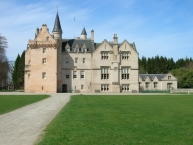
Brodie Castle is a well-preserved Z plan castle located about 3 1⁄2 miles (5.5 kilometres) west of Forres , in Moray, Scotland. The castle is a Category A listed building and the grounds are included in the Inventory of Gardens and Designed Landscapes in Scotland.
The Brodie family
The original Z-plan castle was built in 1567 by Clan Brodie but was destroyed by fire in 1645 by Lewis Gordon of Clan Gordon, the 3rd Marquis of Huntly. In 1824, architect William Burn was commissioned to convert it into a large mansion house in the Scots Baronial style, but these additions were never completed and were later remodelled by James Wylson (c. 1845).
The Brodie family called the castle home until the early 21st century. It is widely accepted that the Brodies have been associated with the land on which the castle is built since around 1160, when it is believed that King Malcolm IV gave the land to the family.
Ninian Brodie of Brodie (The Brodie of Brodie), the castle's last resident member of the family, died in 2003. The former family wing is being[when? ] prepared for holiday letting.
The castle today
Architecturally, the castle has a very well-preserved 16th-century central keep with two 5-storey towers on opposing corners. The interior of the castle is also well preserved, containing fine antique furniture, oriental artifacts and painted ceilings, largely dating from the 17th–19th centuries.
Today the castle and surrounding policies, including a national daffodil collection, are owned by the National Trust for Scotland and are open to the public to visit throughout the year. The castle may be hired for weddings and indoor or outdoor events. An ancient Pictish monument known as Rodney's Stone can be seen in the castle grounds.
Informationen zu Urheber-Rechten | |
|---|---|
Rechte-Ausprägung / Lizenz | by-sa: CREATIVE COMMONS Namensnennung, Weitergabe unter gleichen Bedingungen |
Link zur Rechtebeschreibung | |
Text(e) übernommen von: |
Wikipedia contributors, 'Brodie Castle', Wikipedia, The Free Encyclopedia, 3 August 2020, 18:22 UTC, https://en.wikipedia.org/w/index.php?title=Brodie_Castle&oldid=971018402 [accessed 12 December 2020] |
übernommen / bearbeitet am | 12.12.2020
|
übernommen / bearbeitet durch |
|
Öffnungszeiten
Castle
Guided tours only
2 Jan–29 Feb 2020, Thurs–Sun, 10.00–16.00
1 Mar–19 Mar, daily, 10.00–17.00
20 Mar–31 Dec, closed.
Playful Garden
1 Aug–15 Sep, Wed–Sun, 10.00–17.00
16 Sep–25 Oct, Wed–Sun, 10.00–16.00
26 Oct–31 Dec, Sat & Sun, 10.00–16.00
Garden and grounds
6 Jul–31 Dec, open daily