Radweg Flandernroute
Aktionen

Bitte warten - Kartendaten werden geladen
Erstellt am 02.09.2022,
zuletzt geändert von biroto-Redaktion am 30.12.2022
Aktionen
Strecken-Merkmale
Gesamtlänge in km
959
Informationen zu Rechten an den GPS-Track-Daten | |
|---|---|
Rechte-Inhaber | OpenStreetMap and Contributors + biroto-Redaktion (biroto.eu) |
Rechte-Ausprägung / Lizenz | Enthält Daten von OpenStreetMap, die hier unter der Open Database License(ODbL) verfügbar gemacht werden |
Link zur Rechtebeschreibung | |
gpx-Datei übernommen aus | |
gpx-Datei hochgeladen | durch biroto-Redaktion am 30.12.2022
|
Gesamtzahl Trackpoints
15.298
Trackpoint-Dichte per km
16
Endorte
Start
Leuven, VLG, BE (29 m NHN)
Ziel
Leuven, VLG, BE (32 m NHN)
Wegweisung
Der Radwege ist vollständig und in beiden Richtungen beschildert. |
|

Informations-Quellen
Bücher und Karten:
- Esterbauer bikeline: Flandern - Route: Rundtour auf der Vlaanderen Fietsroute durch den Norden Belgiens. Radtourenbuch und Karte, 140 Seiten, 1:75.000, 830 km, wetterfest/reißfest
Bemerkungen
Die Flandernroute ersetzt seit 2021 die als Flandern Runde bekannten LF Routen LF6/LF1/LF5/LF7.
Fahrradfreundliche Unterkünfte, Sehenswertes und Infrastruktur
Name u. Anschrift
Breite / Länge
Tel.
Fax.
Mobile
Art d. Unterkunft
Radler-freund-lichkeit
Strecken-km
km zur Strecke
Höhe
0 km
0,0 km
20 m
0 km
0,7 km
30 m
3 km
0,2 km
30 m
Informationen zu Urheber-Rechten | |
|---|---|
Rechte-Inhaber | |
Rechte-Ausprägung / Lizenz | by: CREATIVE COMMONS Namensnennung |
Link zur Rechtebeschreibung | |
Bild übernommen aus | https://commons.wikimedia.org/wiki/File:Abdij_van_Park_Leuven_-_panoramio.jpg |
Bild hochgeladen | durch ThimbleU am 17.10.2017
|
Informationen zu Urheber-Rechten | |
|---|---|
Rechte-Inhaber | |
Rechte-Ausprägung / Lizenz | by-sa: CREATIVE COMMONS Namensnennung, Weitergabe unter gleichen Bedingungen |
Link zur Rechtebeschreibung | |
Bild übernommen aus | https://commons.wikimedia.org/wiki/File:Abdij_van_'t_Park_Provisorenhuis.JPG |
Bild hochgeladen | durch ThimbleU am 17.10.2017
|
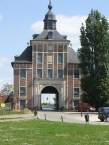
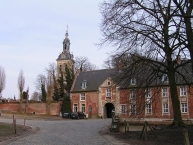
Park Abbey (Dutch: Abdij van Park; also Parc Abbey) is a Premonstratensian abbey in Belgium, at Heverlee  just south of Leuven , in Flemish Brabant.
The Annales Parchenses were written here in the 12th century.
The abbey was founded in 1129 by Duke Godfrey, surnamed "Barbatus" ("the Bearded"), who possessed an immense park near Leuven and had invited the Premonstratensians to take possession of a small church he had built there.
The abbey frequently suffered during the wars waged by William of Orange and the Calvinists.
Under the French Republic the abbey was confiscated again on 1 February 1797. At the request of the people the church was declared to be a parish church and was thus saved. The abbey was bought by a friendly layman who wished to preserve it for the religious, in better times. One of the canons, in the capacity of parish priest, remained in or near the abbey.
When Belgium was made a kingdom and religious freedom was restored, the surviving religious resumed community life and elected Peter Ottoy, then rural dean of Diest, as their superior.
Nowadays it is the best preserved abbey in Belgium. Of particular interest are the Museum Park Abbey and the archives, the premier museum for religious art and culture in Flanders.
Informationen zu Urheber-Rechten | |
|---|---|
Rechte-Ausprägung / Lizenz | by-sa: CREATIVE COMMONS Namensnennung, Weitergabe unter gleichen Bedingungen |
Link zur Rechtebeschreibung | |
Text(e) übernommen von: |
Wikipedia contributors, 'Park Abbey', Wikipedia, The Free Encyclopedia, 19 August 2017, 23:02 UTC, <https://en.wikipedia.org/w/index.php?title=Park_Abbey&oldid=796308833> [accessed 17 October 2017] |
übernommen / bearbeitet am | 17.10.2017
|
übernommen / bearbeitet durch |
|
Öffnungszeiten
Tuesday - Sunday from 10h to 17h
Closed on Mondays and public holidays
4 km
0,1 km
19 m
6 km
0,1 km
19 m
Informationen zu Urheber-Rechten | |
|---|---|
Rechte-Inhaber | |
Rechte-Ausprägung / Lizenz | by-sa: CREATIVE COMMONS Namensnennung, Weitergabe unter gleichen Bedingungen |
Link zur Rechtebeschreibung | |
Bild übernommen aus | https://commons.wikimedia.org/wiki/File:Castle_Arenberg,_Katholieke_Universiteit_Leuven_adj.jpg |
Bild hochgeladen | durch ThimbleU am 17.10.2017
|
Informationen zu Urheber-Rechten | |
|---|---|
Rechte-Inhaber | |
Rechte-Ausprägung / Lizenz | by: CREATIVE COMMONS Namensnennung |
Link zur Rechtebeschreibung | |
Bild übernommen aus | https://commons.wikimedia.org/wiki/File:Leuven_University_-_panoramio_(1).jpg |
Bild hochgeladen | durch ThimbleU am 17.10.2017
|
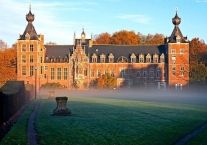
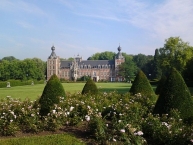
Kasteel van Arenberg is a château in Heverlee close to Leuven in Belgium. It is surrounded by a park.
The site had been the castle of the lords of Heverlee since the 12th century, but this family became impoverished and had to sell the site in 1445 to the Croÿ family from Picardy. Antoon van Croy demolished the medieval castle and started works to build the current château in 1455 on the site, of which he destroyed all but one tower. Willem van Croÿ completed the works on the château in 1515, and founded a monastery on the château grounds for the Benedictine Celestines. The architectural style is in large part traditionally Flemish, with sandstone window frames and brick walls, though it has been structurally altered since 1515 and has elements of Gothic, Renaissance and Neo Gothic architecture. Its large corner towers are typical, once surmounted by a German eagle.
Charles III of Croy was the 4th and last duke, and after his death in 1612 without issue the château passed to the Arenberg family into which his sister had married, and remained in that family until the First World War.
The château and park were seized by the Belgian government on the outbreak of, and then after the war since the Arenberg family was considered to be German or Austrian due to their close Habsburg connection, monarchs of Austria-Hungary. It took until 1921 for the University to acquire them, becoming an expanded natural sciences and engineering campus in the style of that of an American university. After the partitioning of the university along language lines in 1968, the château and grounds remained with the Dutch speaking half as one of the main campuses for the new, independent Katholieke Universiteit Leuven. The château itself is now used by the Engineering Science faculty of the KU Leuven and is the focal point of a green campus for the group Sciences & Technology.
The former Celestine monastery on the château grounds now houses the campus library, and the addresses of many of the science buildings are on the street named Celestijnenlaan (Dutch for "Celestine Street").
Informationen zu Urheber-Rechten | |
|---|---|
Rechte-Ausprägung / Lizenz | by-sa: CREATIVE COMMONS Namensnennung, Weitergabe unter gleichen Bedingungen |
Link zur Rechtebeschreibung | |
Text(e) übernommen von: |
Wikipedia contributors, 'Kasteel van Arenberg', Wikipedia, The Free Encyclopedia, 17 November 2015, 13:44 UTC, <https://en.wikipedia.org/w/index.php?title=Kasteel_van_Arenberg&oldid=691071901> [accessed 17 October 2017] |
übernommen / bearbeitet am | 17.10.2017
|
übernommen / bearbeitet durch |
|
Öffnungszeiten
The castle is open to students during the academic year, but unfortunately not accessible to visitors.