Radweg Camino del Cid
Aktionen

Bitte warten - Kartendaten werden geladen
Erstellt am 01.08.2017,
zuletzt geändert von biroto-Redaktion am 07.02.2021
Aktionen
Strecken-Merkmale
Gesamtlänge in km
1.379
Informationen zu Rechten an den GPS-Track-Daten | |
|---|---|
Rechte-Inhaber | OpenStreetMap and Contributors + biroto-Redaktion (biroto.eu) |
Rechte-Ausprägung / Lizenz | Enthält Daten von OpenStreetMap, die hier unter der Open Database License(ODbL) verfügbar gemacht werden |
Link zur Rechtebeschreibung | |
gpx-Datei übernommen aus | |
gpx-Datei hochgeladen | durch biroto-Redaktion am 03.02.2021
|
Gesamtzahl Trackpoints
20.213
Trackpoint-Dichte per km
15
Endorte
Start
Quintanilla Vivar, Castile and León, ES (855 m NHN)
Ziel
Orihuela, Valencian Community, ES (27 m NHN)
Charakter
The Way of El Cid is a cultural and tourist route that crosses Spain from the northwest to the southeast, from Castilla to the Mediterranean coast. It follows the history and the legend of Rodrigo Díaz de Vivar, El Cid Campeador, a medieval knight of the 11th century and one of Spain’s greatest characters. El Cid is not only a literary character, also a historical figure.
The main travel guide on the route is the Cantar de mio Cid, the great Hispanic medieval epic poem written at the end of the 12th century or beginning of the 13th. It tells of the adventures of El Cid Campeador as from his exile, fighting to survive against Moors and Christians.
The route crosses eight Spanish provinces (Burgos, Soria, Guadalajara, Zaragoza, Teruel, Castellón, Valencia and Alicante) belonging to four Autonomous Communities (Castile and Leon, Castilla-La Mancha, Aragon and Valencian Community).
Origins of the Camino del Cid
The Camino del Cid is an itinerary inspired by El Cantar de mio Cid. In it, the author makes references to both history and fiction. The route taken by the historic Cid does not correspond exactly with that described in the poem. The author would have used available historical references added to his own knowledge of geography to draw a route traced mainly by Roman roads, trade routes, and historic paths. This network of paths, some of which still exist today, began to be traveled as itineraries of the Cid towards the end of the nineteenth century by Archer Milton Huntington, founder of the Hispanic Society of America, followed shortly thereafter by the search for traces of the Cid through the Castilian and Aragonese lands by the philologist Ramón Menéndez Pidal and his wife Maria Goyri.
With only a few exceptions, travellers will come across all the scenarios mentioned in the poem on this route. In some cases, some villages have been associated with the same place name, as is the case of El Robledal de Corpes. The location of this place, which is where the imaginary affront to El Cid's daughters occurs, has captured the attention of many academics.
Road cycling tourism routes
The road cycling routes on the Way of El Cid (touring, trekking, hybrid and road bikes) are on mainly quiet minor roads with little or hardly any traffic. However, there are also some sections along regional and national roads and connections to dual carriageways: in general, but not always, these roads have a generous hard shoulder.
The cycling tourist routes are suitable to cyclists with all kinds of bikes: from road to all-terrain. The bikes best suited to these routes are the gravel´s and the touring bikes (also called trekking, or hybrid) owing to their versatility: In comparison with mountain bikes, touring and gravel bikes are faster, especially on flats and downhill sections. They are more comfortable than racing bikes when the road surface is in bad condition or wet, but they also let tourists change over to the mountain bike routes (MTB): many sections are very easy and comfortable for trekking bikes.
The Way of el Cid credential
The Letter of Safe Conduct is the credential that features the stamps of the various towns and villages travellers pass through. It is based on the document used during the Middle Ages to ensure that travellers and goods were allowed to travel freely and safely.
It is a memento of the experience travelling the Way of El Cid: the stamps are much sought-after. The collection was designed by Julián de Velasco. Also it It is a way of discovering the history of the towns and villages pass through The Way of el Cid: each stamp reminds of a historic or legendary event, or part of the local heritage.
The Letter of Safe Conduct entitles to discounts of around 10% at more than two hundred accommodation options on the Way of El Cid. In addition, can use the Letter of Safe Conduct to take advantage regular promotions and free gifts, including bracelets, badges, caps, bandolera scarves and T-shirts, etc. If collect four stamps from at least seven of the eight provinces the Way passes through, will receive the Way of El Cid certificate free of charge.
The Letter of Safe Conduct is free of charge, can be apply by mail or asking in person at any of the 81 Tourist Information Offices located along the Way of El Cid.
Informationen zu Urheber-Rechten | |
|---|---|
Rechte-Ausprägung / Lizenz | by-sa: CREATIVE COMMONS Namensnennung, Weitergabe unter gleichen Bedingungen |
Link zur Rechtebeschreibung | |
Text(e) übernommen von: |
Wikipedia contributors, 'Camino del Cid', Wikipedia, The Free Encyclopedia, 30 December 2020, 11:14 UTC, https://en.wikipedia.org/w/index.php?title=Camino_del_Cid&oldid=997188898 [accessed 7 February 2021] |
übernommen / bearbeitet am | 07.02.2021
|
übernommen / bearbeitet durch |
|
Wegweisung
|

Informations-Quellen
Web-Sites:
Fahrradfreundliche Unterkünfte, Sehenswertes und Infrastruktur
Name u. Anschrift
Breite / Länge
Tel.
Fax.
Mobile
Art d. Unterkunft
Radler-freund-lichkeit
Strecken-km
km zur Strecke
Höhe
0 km
0,1 km
862 m
11 km
0,9 km
845 m
Informationen zu Urheber-Rechten | |
|---|---|
Rechte-Inhaber | |
Rechte-Ausprägung / Lizenz | by-sa: CREATIVE COMMONS Namensnennung, Weitergabe unter gleichen Bedingungen |
Link zur Rechtebeschreibung | |
Bild übernommen aus | commons.wikimedia.org/wiki/File:Burgos_monasterio_huelgas_lou.JPG |
Bild hochgeladen | durch biroto-Redaktion am 15.03.2015
|
Informationen zu Urheber-Rechten | |
|---|---|
Rechte-Inhaber | |
Rechte-Ausprägung / Lizenz | by-sa: CREATIVE COMMONS Namensnennung, Weitergabe unter gleichen Bedingungen |
Link zur Rechtebeschreibung | |
Bild übernommen aus | commons.wikimedia.org/wiki/File:Monasterio_de_las_Huelgas,_Claustro_de_San_Fernando.JPG |
Bild hochgeladen | durch biroto-Redaktion am 15.03.2015
|
Informationen zu Urheber-Rechten | |
|---|---|
Rechte-Inhaber | |
Rechte-Ausprägung / Lizenz | by-sa: CREATIVE COMMONS Namensnennung, Weitergabe unter gleichen Bedingungen |
Link zur Rechtebeschreibung | |
Bild übernommen aus | |
Bild hochgeladen | durch biroto-Redaktion am 15.03.2015
|
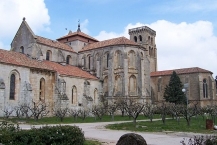
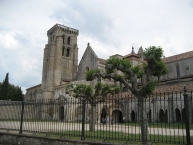
Das königliche Kloster Santa María la Real de Las Huelgas ist eine Zisterzienserinnenabtei und liegt 1,5 Kilometer westlich der Stadt Burgos  an der Avenida del Monasterio de las Huelgas.
Der kastilische König Alfons VIII. (regierte 1158-1214) und seine Ehefrau Eleonore Plantagenet gründeten 1187 in der Nähe von Burgos an der Stelle, an der sich bis dahin eine königliche Lustresidenz befunden hatte, die Abtei Santa María la Real, besser bekannt als Las Huelgas Reales (übersetzt etwa: königliches Freizeitdomizil).
Der 1186-1189 amtierende Abt Wilhelm II. von Cîteaux (auch unter seinem französischen Namen Guillaume II. de la Prée bekannt) gab im September des Jahres 1187 seine Zustimmung zur Gründung des Nonnenklosters, wobei er festlegte, dass die Nonnen selbst einen oder zwei Äbte aus regionalen männlichen Zisterzienserabteien zu ihren Visitatoren wählen durften. Eleonora, die Tochter der Eleonore von Aquitanien (die sich in die Abtei Fontevrault zurückgezogen hatte) und des englischen Königs Heinrich II, hatte wesentlichen Anteil daran, diese bevorzugte Behandlung des Klosters durchzusetzen (andere Nonnenklöster konnten sich ihre Visitatoren nicht aussuchen).
Die ersten Nonnen kamen aus der Abtei Tulebras in Navarra, die 1157 gegründet worden war, erste Äbtissin war Doña Misol. Alfons VIII. sah seine Gründung als Haupt einer Kongregation, in die die anderen kastilischen Zisterzienserinnen eingebunden werden sollten.
Das Kloster Las Huelgas wurde von seinen Gründern reich beschenkt, es erhielt 49 Güter, darunter das Hospital del Rey in unmittelbarer Nähe. Darüber hinaus wurde es 1199 zur Begräbnisstätte der königlichen Familie erklärt. Die Abtei besaß ein umfangreiches Herrschaftsgebiet, in dem sie die weltliche und geistliche Jurisdiktion ausübte und unabhängig von den Bischöfen von Burgos agierte.
Machtfülle und Reichtum des Klosters führten auch dazu, dass mit der Zeit eine wichtige Bibliothek entstand. Die Abtei besitzt unter anderem ein Lektionar aus dem Skriptorium der nahe gelegenen Zisterzienserabtei San Pedro de Cardeña , eine Bibel aus dem Jahr 1181, einen Kommentar zu Apokalypse des Beatus von Liébana aus dem Jahr 1220 sowie eine Abschrift der Benediktinerregel aus dem Jahr 1246.
Die Arbeiten am Kloster begannen noch im Jahr 1187 und wurden in der zweiten Hälfte des 13. Jahrhunderts abgeschlossen.
Das Kloster beherbergt auch heute einen Konvent von Zisterzienserinnen. Das bauliche Ensemble ist ein nationales Kunstdenkmal.
Kirche
Das Äußere der Kirche weist die klaren Linien der Kunst der Zisterzienser auf. Im Inneren ist sie durch eine Abtrennung zwischen den Bereichen der Gläubigen und der Nonnen in zwei Teile geteilt. Diese wird auf der Seite des Kirchenschiffs durch eine Kreuzabnahme aus dem 13. Jahrhundert überragt. In der zentralen Kapelle hinter dem großen Altar befindet sich ein Barock-Retabel aus dem Jahr 1665, auf dem die Himmelfahrt Marias von Statuen der Heiligen Benedikt von Nursia und Bernhard von Clairvaux sowie des Gründerpaares umrahmt wird. Über der Verbindung mit dem Zentralschiff stellt ein Bild aus dem Jahr 1594 die Schlacht bei Las Navas de Tolosa (16. Juli 1212) dar, in der Alfons VIII. kämpfte.
Das zentrale Kirchenschiff, das von zwei Seitenschiffen begleitet wird, beherbergt den Doppelsarkophag für Alfons VIII. und Eleonore, die beide im Jahr 1214 starben. Hier sowie an den Seiten fanden auch viele weitere Sarkophage Platz, wie zum Beispiel im Katharinen-Schiff der des Infanten Ferdinand de la Cerda, des Sohnes des Königs Alfons X, der im Jahr 1275 starb.
Vom Johannes-Schiff aus kann man durch zwei Tore in das gotische Kloster gelangen.
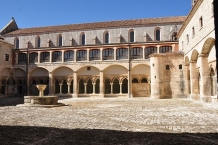
Kloster San Fernando
Das gotische Kloster San Fernando stammt aus dem 13. bis 15. Jahrhundert. Hier existieren Fragmente von Stuckarbeiten im Mudéjar-Stil in den Galeriegewölben aus den Jahren 1230 bis 1260
Das romanische Kloster
Das romanische Kloster stammt – wie die Auferstehungskapelle an seiner Nordostecke im Mudéjar Stil – aus den Jahren 1180 bis 1190 und befindet sich südlich vom gotischen. Hier verleihen doppelte Säulenreihen mit stilvoll ausgearbeiteten Kapitellen dem Kloster Eleganz. Man durchquert anschließend mehrere Säle des Palastes Alfons’ X. in maurischer Dekoration.
Kapelle des Heiligen Jakobus
Im Osten des Klosters hat sich etwas abseits in der Kapelle des Heiligen Jakobus eine Decke aus dem Ende des 13. Jahrhunderts erhalten, deren Farbigkeit und deren Stuckfriese original sind.
Museum für mittelalterliche Stoffe
Das Museum ist in einem Saal untergebracht, der sich zum Kloster hin öffnet. Die Stoffe und der Putz, die in dem ehemaligen Kornspeicher gezeigt werden, sind Belege für die königliche Kleidung im Kastilien des 13. Jahrhunderts. Die Kleidungsstücke (Tunika, Pelze und Umhänge) wurden in den Gräbern gefunden. Die kostbarsten stammen aus dem Grab Ferdinando de la Cerdas, das von den Soldaten Napoleons im Jahr 1809 nicht geschändet wurde.
Kapitelsaal
Der Kapitelsaal öffnet sich auf die östliche Galerie und beherbergt den „Pendòn“, eine Trophäe aus der Schlacht bei Las Navas de Tolosa. Er stammt aus dem Zelt von Muhammad an-Nasir, dem besiegten almohadischen Feldherrn.
Informationen zu Urheber-Rechten | |
|---|---|
Rechte-Ausprägung / Lizenz | by-sa: CREATIVE COMMONS Namensnennung, Weitergabe unter gleichen Bedingungen |
Link zur Rechtebeschreibung | |
Text(e) übernommen von: |
Seite „Las Huelgas“. In: Wikipedia, Die freie Enzyklopädie. Bearbeitungsstand: 14. November 2013, 17:24 UTC. URL: http://de.wikipedia.org/w/index.php?title=Las_Huelgas&oldid=124463378 (Abgerufen: 15. März 2015, 11:17 UTC) |
übernommen / bearbeitet am | 15.03.2015
|
übernommen / bearbeitet durch |
|
Öffnungszeiten
Tuesday to Saturday: 10:00 to 13: 00h and 16:00 to 17: 30h
Sundays and holidays: 10: 30h to 14: 00h.
Closed: Monday; 1 and 6 January; Good Friday; May 1; Curpillos; 29 June; 6, 24, 25 and 31 December
12 km
0,1 km
876 m
12 km
0,1 km
876 m
12 km
0,0 km
863 m
Öffnungszeiten
September 30 to June 30
from Monday to Saturday from 10:00 to 14:00 and 16:00 to 19:00
Sunday 10:00 to 17:00
July 1 to August 31
from Monday to Sunday 10:00 to 8:00 p.m.