Cycle Route Oder River Trail
Actions

Please wait - map data are loading
Added on 16 Dec 2012,
last edited by biroto-Redaktion on 15 Jan 2021
Actions
Cycle route metrics
Total distance in km
1.150
Information about rights to the gps-track data | |
|---|---|
Rights owner | OpenStreetMap and Contributors + biroto-Redaktion (biroto.eu) |
Rights characteristic / license | Contains information from OpenStreetMap, which is made available here under the Open Database License(ODbL) |
Link to the description of the license | |
GPX file taken from | |
GPX file uploaded | by biroto-Redaktion on 15 Jan 2021
|
Track points in total
13.905
Track points per km (avg)
12
Start/endpoint
Start location
Odry, Moravia-Silesia, CZ (333 m NHN)
End location
Stettin, Woiwodschaft Westpommern, PL (1 m NHN)
Remarks
Der Track folgt den Radwegen
- Krnov - Starý Jičín
- EuroVelo 4 - Mitteleuropa-Route (EuroVelo 4 - Szlak Europy Centralnej)
- Oder-Radweg (Greenway Rowerowy Szlak Odry)
- Grüne Oder (Zielona Odra)
- Stettiner Haff Radweg
um der Oder aus dem mährischen Odergebirge bis zum Stettiner Haff zu folgen.
Beds4Cyclists, worth visiting and infrastructure
Name and address
Latitude / Longitude
Phone
Fax
Mobile
Type of accommodation
Rating for cyclists
Route km
Dist. to route
Elevation
11 km
0,0 km
281 m
26 km
1,6 km
251 m
30 km
4,9 km
275 m
30 km
4,6 km
305 m
Information about copyright | |
|---|---|
Rights owner | |
Rights characteristic / license | by-sa: CREATIVE COMMONS Attribution-ShareAlike |
Link to the description of the license | |
Image taken over from | |
Image has been uploaded | by biroto-Redaktion on 11 Oct 2019
|
Information about copyright | |
|---|---|
Rights owner | |
Rights characteristic / license | by-sa: CREATIVE COMMONS Attribution-ShareAlike |
Link to the description of the license | |
Image taken over from | |
Image has been uploaded | by biroto-Redaktion on 11 Oct 2019
|
Information about copyright | |
|---|---|
Rights owner | |
Rights characteristic / license | by-sa: CREATIVE COMMONS Attribution-ShareAlike |
Link to the description of the license | |
Image taken over from | |
Image has been uploaded | by biroto-Redaktion on 11 Oct 2019
|
Information about copyright | |
|---|---|
Rights owner | |
Rights characteristic / license | by-sa: CREATIVE COMMONS Attribution-ShareAlike |
Link to the description of the license | |
Image taken over from | https://commons.wikimedia.org/wiki/File:NJicin_Farska_bašta_1613_DSCN7349.JPG |
Image has been uploaded | by biroto-Redaktion on 11 Oct 2019
|
Nový Jičín (deutsch Neu Titschein oder Neutitschein) ist eine Stadt in der Mährisch-Schlesischen Region in Tschechien. Die Stadt hat etwa 24.000 Einwohner. Das historische Stadtzentrum wurde 1967 zum städtischen Denkmalreservat  erklärt.
Geschichte
Die Gründung der Stadt fällt wahrscheinlich in das 13. Jahrhundert. Bereits 1313 erhielt Neutitschein das Stadtrecht, das auch mit dem Recht zur Erhebung von Zöllen verbunden war. Inmitten des Kuhländchens gelegen, war die Stadt berühmt wegen ihrer Viehmärkte, der Tucherzeugung (Firma Preisenhammer, gegründet 1786) und der Herstellung von Hüten (Firma Hückel, gegründet 1799; Firma August Peschel, gegründet 1869 und Firma Böhm). Neutitschein war der Geburtsort der Maler Hugo Baar, Julius Berger, Anton Kolig und Eduard Veith. Am Stadtplatz 29 verstarb am 14. Juli 1790 der österreichische Feldherr Ernst Gideon von Laudon.
Nach dem Ende des Ersten Weltkrieges kam es zum Zerfall der Doppelmonarchie, aus der neue Staaten hervorgingen, so die Tschechoslowakei (1. ČSR) am 28. Oktober 1918 und die Republik Deutschösterreich am 12. November 1918, dem Tag nach der Verzichtserklärung von Kaiser Karl I. und der Enthebung seiner letzten Regierung.
Seit 1967 steht das Zentrum der Bezirksstadt des Okres Nový Jičín mit ihren zahlreichen Architekturdenkmälern unter Denkmalschutz.
Sehenswürdigkeiten
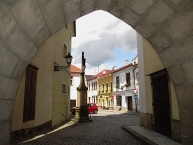
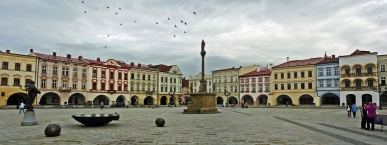
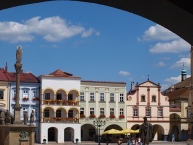
- ⊙Masaryk Platz mit Arkaden, einer Reihe von historischen Häusern und Mariensäule aus dem Jahr 1710 in der Mitte. Ein kleiner Brunnen mit einer Bronzeskulptur von P. Barwiga.
- ⊙Altes Posthaus (Masarykovo náměstí 20) mit doppelter Renaissance-Loggia aus dem Jahr 1563
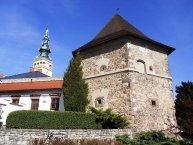
- ⊙ Mauerreste aus dem 16. Jahrhundert mit der Farská-Bastei aus dem Jahr 1613 in der östlichen Mauerecke.
- ⊙ Das Renaissance-Schloss Žerotín südlich des Platzes wurde in den Jahren 1533–1558 aus einem älteren Herrenhaus umgebaut und Ende des 19. Jahrhunderts romantisch umgebaut. Heute beherbergt es ein Museum.
- ⊙ Die Pfarrkirche Mariä Himmelfahrt ist ein dreischiffiges Barockgebäude mit Seitenoratorien, das 1729–1734 auf älteren Fundamenten erbaut wurde. Der Turm in der Westfassade stammt aus den Jahren 1587–1618, wie die lateinische Inschrift über dem Tor belegt. Die Kirche verfügt über eine wertvolle Barockausstattung, ein Altarbild von Elias Herbert aus dem Jahr 1739, Skulpturen von O. Zahner und geschnitzte Kirchenbänke aus derselben Zeit.
- ⊙ Die Dreifaltigkeitskirche aus der Zeit um 1500 ist ein einschiffiges rechteckiges Gebäude mit einer fünfeckigen Oberfläche und einem Turm auf der Achse der Westfassade. Die Kirche wurde wahrscheinlich von den Utraquisten und den Böhmischen Brüdern genutzt, nach 1650 wurde der Turm fertiggestellt und gegen Ende des 17. Jahrhunderts der größte Teil der Innenausstattung.
Information about copyright | |
|---|---|
Rights characteristic / license | by-sa: CREATIVE COMMONS Attribution-ShareAlike |
Link to the description of the license | |
Input taken over from: |
|
taken over / edited on | 11 Oct 2019
|
taken over / edited by |
|
38 km
0,1 km
243 m